🎉 Buy more than $300 and get 20% OFF with coupon
0
Your Cart
0
Your Cart
Advanced On-Demand Clinical AI Course

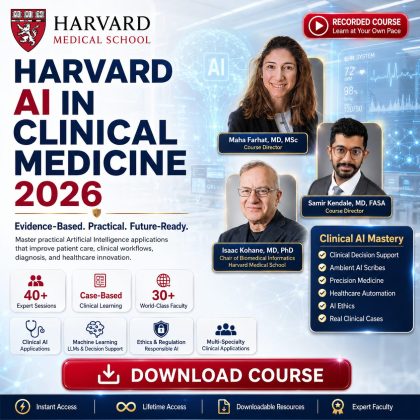
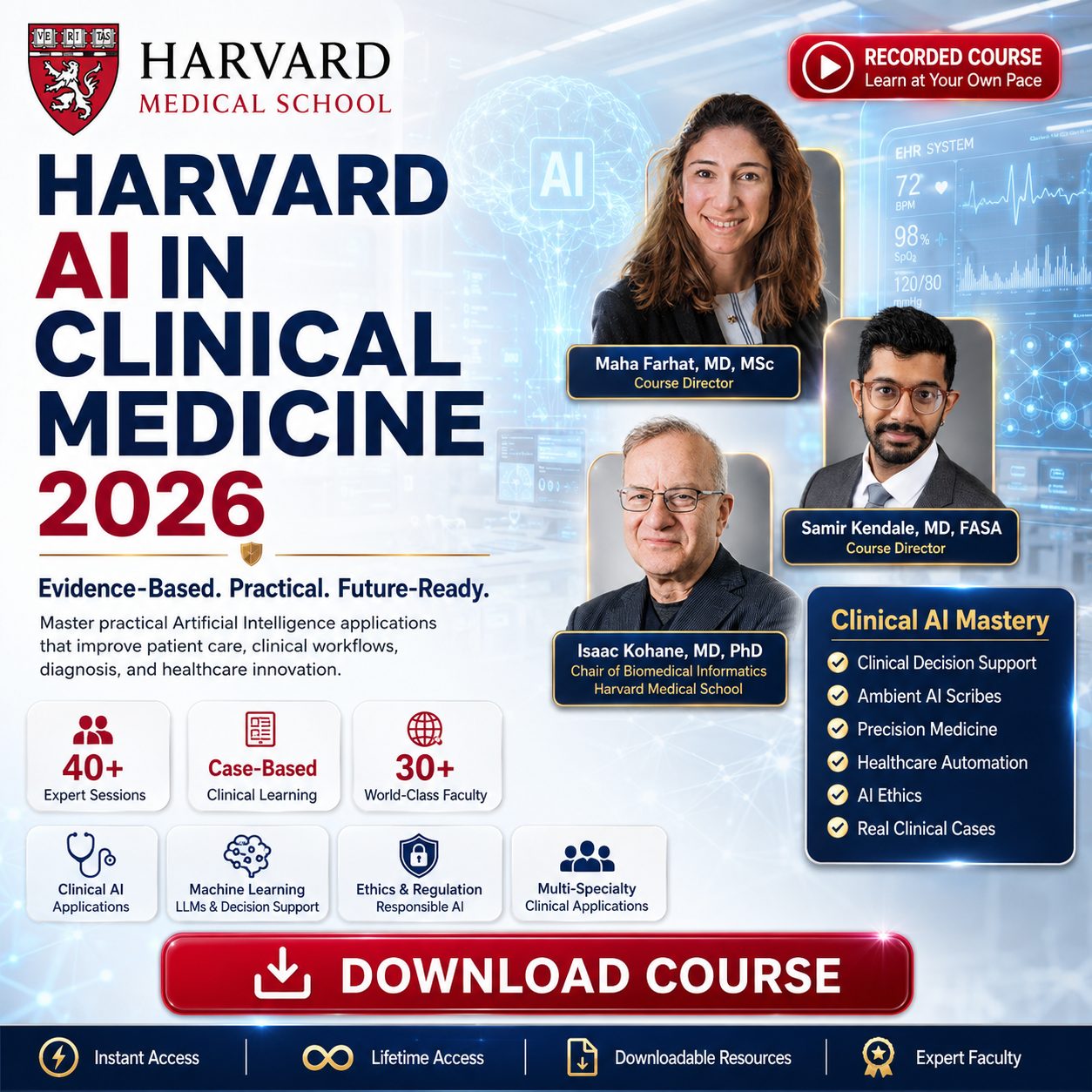
Harvard AI in Clinical Medicine

Apply artificial intelligence with greater confidence across modern clinical care

Gain practical insight into machine learning, large language models, clinical decision support, ambient scribes, precision medicine, ethics, regulation, bias, and real-world AI implementation.

Course Overview

Cut through the hype and understand how AI is changing clinical medicine

The digitization of health records has created new opportunities for automation, predictive analytics, personalized treatment, clinical decision support, and data-driven patient care.

This multidisciplinary course explores practical applications of artificial intelligence through expert lectures, panel discussions, specialty study halls, demonstrations, and real-world case examples.

Participants examine the opportunities, risks, ethical questions, regulatory challenges, and implementation barriers associated with introducing AI into hospitals, health systems, academic centers, and independent practices.

  • Understand machine learning, deep learning, and large language models
  • Explore ambient scribes and clinical documentation automation
  • Assess AI applications in diagnosis, monitoring, and treatment planning
  • Review ethics, bias, privacy, law, regulation, and model reliability
  • Apply practical AI strategies across multiple clinical specialties
Program Schedule

Complete Three-Day Course Curriculum

Open each section to review lecture times, session topics, and faculty speakers.

Day 1 — AI Foundations, Education, and Precision Medicine 16 sessions
  • 9:00–9:05 amWelcomeMaha Farhat; Samir Kendale; Isaac Kohane
  • 9:05–9:50 amKeynote: Paging Dr. A.I.: How AI Is Changing the Face of Clinical CareIsaac Kohane
  • 9:50–10:00 amKeynote Q&AIsaac Kohane
  • 10:00–10:45 amLearning the AI Lingo: Machine Learning, Deep Learning, and Large Language ModelsSamir Kendale
  • 10:45–11:15 amA Look Into the Black Box: Technical Background for CliniciansMaha Farhat
  • 11:15–11:45 amMedical Data as the Backbone of AIMatthew Engelhard
  • 11:45 am–12:15 pmPanel DiscussionSamir Kendale; Maha Farhat; Matthew Engelhard
  • 12:15–12:45 pmBreak—
  • 12:45–1:30 pmChatbots in Health Care: A Historical ExpeditionArjun Manrai
  • 1:30–2:15 pmAI Learning Revolution: Transforming Medical EducationAdam Rodman
  • 2:15–2:45 pmAmbient ScribesAllison Koenecke
  • 2:45–3:15 pmPanel Discussion and Q&AAdam Rodman; Arjun Manrai; Allison Koenecke
  • 3:30–4:00 pmAn AI-Designed Drug for IPF: From Preclinical Development to Phase II in Under Three YearsToby Maher
  • 4:00–4:30 pmPrecision Medicine: AI and Personalized Treatment in OncologyEliezer Van Allen
  • 4:30–5:00 pmAI-Powered Drug Repositioning and Clinical Trial DesignDavid Tester
  • 5:00–5:30 pmPanel Discussion and Q&AToby Maher; Eliezer Van Allen; David Tester
Day 2 — Ethics, Leadership, Regulation, Bias, and Emerging Care Models 14 sessions
  • 9:00–9:05 amWelcomeMaha Farhat; Samir Kendale; Isaac Kohane
  • 9:05–9:50 amKeynote: Ethics and AI in HealthcareRebecca Weintraub Brendel
  • 9:50–10:35 amAI for Pioneering Leadership in the Digital EraStanley Y. Shaw
  • 10:35–11:20 amLaw and Regulation in AII. Glenn Cohen
  • 11:20–11:50 amPanel Discussion and Q&AIsaac Kohane; Rebecca Weintraub Brendel; Stanley Y. Shaw
  • 11:50 am–12:30 pmBreak—
  • 12:30–1:05 pmTelemetry and Mobile Health for Early Detection of Heart Failure ExacerbationCollin Stultz
  • 1:05–1:40 pmBrain-Computer Interfaces and Decoding SpeechZiv Williams
  • 1:40–2:15 pmCan Chatbots Improve Mental Health?Michael Heinz
  • 2:15–2:45 pmPanel Discussion and Q&ACollin Stultz; Ziv Williams; Michael Heinz
  • 3:00–3:35 pmBias in Risk Stratification for Allocation and PolicyEmma Pierson
  • 3:35–4:10 pmRobust, Fair, and Private AIMaia Hightower
  • 4:10–4:45 pmAlgorithmic Bias in Clinical Scores and Implications for AIJames Diao
  • 4:45–5:15 pmPanel Discussion and Q&AEmma Pierson; James Diao; Maia Hightower
Day 3 — Implementation, Operations, and Specialty Study Halls 22 sessions
  • 9:00–9:05 amWelcomeSamir Kendale; Maha Farhat; Isaac Kohane
  • 9:05–9:35 amBut I Want It Now!: Barriers to Clinical AI ImplementationSamir Kendale
  • 9:35–10:05 amHow Can I Help You? Clinical Decision Support in the EHRNatalie Pageler
  • 10:05–10:35 amImplementing AI in Your Small PracticeAdam Rodman
  • 10:35–11:05 amHidden Risks of AI in Your PracticeDavid Canes
  • 11:05–11:35 amPanel Discussion and Q&ASamir Kendale; Natalie Pageler; Adam Rodman; David Canes
  • 11:50 am–12:20 pmMoney Talks: How AI Can Help Improve Your Bottom LineJean-Claude Saghbini
  • 12:20–12:50 pmAI and Reducing Healthcare Provider BurnoutAnand Chowdhury
  • 12:50–1:20 pmWhy AI May Be Good for Our Health but Hurt Our WalletsMorgan Cheatham
  • 1:20–1:50 pmPanel Discussion and Q&AAnand Chowdhury; Morgan Cheatham; Jean-Claude Saghbini
  • 2:20–3:20 pmStudy Hall — Clinical Applications: PathologyKun-Hsing “Kun” Yu
  • 2:20–3:20 pmStudy Hall — Clinical Applications: EndocrinologyDavid Klonoff
  • 2:20–3:20 pmStudy Hall — Clinical Applications: OphthalmologyNazlee Zebardast
  • 2:20–3:20 pmStudy Hall — Clinical Applications: NursingKenya Beard
  • 3:25–4:25 pmStudy Hall — Clinical Applications: GastroenterologySeth Gross
  • 3:25–4:25 pmStudy Hall — Clinical Applications: Critical CareSivasubramanium Bhavani
  • 3:25–4:25 pmStudy Hall — Clinical Applications: RadiologyWilliam Lotter
  • 3:25–4:25 pmStudy Hall — Clinical Applications: Surgery or AnesthesiaDaniel Hashimoto
  • 4:40–5:40 pmVirtual Demonstration: Ambient Scribe From AbridgeMatt Troup; Chase Yarbrough
  • 4:40–5:40 pmVirtual Demonstration: Leveraging Clinician Expertise With Agentic AIMatthew Sakumoto
  • 4:40–5:40 pmVirtual Demonstrations: OpenEvidence, Doctronic, UpToDate Expert AI, and Glass HealthTravis Zack; Byron Crowe; Sheila Bond; Dereck Paul
Course Leadership

Learn from internationally recognized leaders in clinical AI

The course is directed by experts in biomedical informatics, clinical medicine, anesthesia informatics, and data-driven health care.

Maha Farhat, MD, MSc
Course Director

Maha Farhat, MD, MSc

Gilbert S. Omenn Associate Professor of Biomedical Informatics and physician at Massachusetts General Hospital.

Samir Kendale, MD, FASA
Course Director

Samir Kendale, MD, FASA

Assistant Professor of Anaesthesia and Medical Director of Anesthesia Informatics.

Isaac Kohane, MD, PhD
Course Director

Isaac Kohane, MD, PhD

Chair of Biomedical Informatics and Marion V. Nelson Professor of Biomedical Informatics.

Monica Agrawal, PhD

Assistant Professor, Duke University; Co-founder, Layer Health.

Kenya V. Beard, EdD

President, K Beard & Associates, LLC.

Tyler Berzin, MD

Associate Professor of Medicine, Harvard Medical School.

Sivasubramanium Bhavani, MD

Assistant Professor of Medicine, Emory University.

Sheila A. Bond, MD

Director, Clinical Content Strategy, Wolters Kluwer Health.

David Canes, MD

Urologist specializing in robotic prostatectomy and kidney surgery.

Leo Celi, MD

Principal Research Scientist, MIT; Associate Professor, Harvard Medical School.

Morgan Cheatham, MD

Partner and Head of Healthcare and Life Science, Breyer Capital.

Anand Chowdhury, MD

Critical Care Specialist and Pulmonologist, Duke Hospital.

I. Glenn Cohen

Professor of Law and Faculty Director, Petrie-Flom Center.

Byron Crowe, MD

Chief Medical Officer, Doctronic.

Roxana Daneshjou, MD, PhD

Assistant Professor of Biomedical Data Science and Dermatology, Stanford.

James Diao, MD

Faculty, Brigham and Women’s Hospital.

Matthew Engelhard, MD, PhD

Assistant Professor of Biostatistics, Bioinformatics, and Engineering, Duke University.

Seth A. Gross, MD

Clinical Chief of Gastroenterology and Hepatology, NYU Langone Health.

Daniel A. Hashimoto, MD

Assistant Professor of Surgery, University of Pennsylvania.

Michael Heinz, MD

Research Psychiatrist, Dartmouth College and Dartmouth Health.

Maia Hightower, MD, MPH, MBA

Healthcare AI and Digital Transformation Advisor.

David C. Klonoff, MD

President, Diabetes Technology Management, Inc.

Allison Koenecke, PhD

Assistant Professor of Information Science, Cornell Tech.

Constance Leman, MD, PhD

Diagnostic Radiologist, Massachusetts General Hospital.

William Lotter, PhD

Assistant Professor, Dana-Farber Cancer Institute and Harvard Medical School.

Toby Michael Maher, MD, PhD

Pulmonary and Critical Care, Keck Medicine of USC.

Arjun Manrai, PhD

Assistant Professor of Biomedical Informatics; Senior Deputy Editor, NEJM AI.

Genevieve Melton-Meaux, MD, PhD

Chief Health Informatics and AI Officer and Professor of Surgery.

David Ouyang, MD

Research Scientist and Non-Invasive Cardiologist, Kaiser Permanente.

Natalie Pageler, MD, MEd

Chief Health Informatics Officer, Stanford Children’s Health.

Dereck Paul, MD

Co-Founder and CEO, Glass Health.

Emma Pierson, PhD

Assistant Professor of Computer Science and AI researcher.

Pranav Rajpurkar, PhD

Assistant Professor of Biomedical Informatics, Harvard Medical School.

Adam Rodman, MD, MPH

Director of AI Programs, Shapiro Center for Research and Education.

Jean-Claude Saghbini, PhD

President, Lumeris Technology Services.

Matthew Sakumoto, MD

Internal Medicine Physician, UCSF.

Stanley Y. Shaw, MD, PhD

Associate Vice President, Digital Medicine, Amgen.

Collin M. Stultz, MD, PhD

Professor and Director, Harvard-MIT Health Sciences and Technology.

David Tester, PhD

Founder and CEO, Tapestry Bio.

Matt Troup, PA-C

Clinical Strategy Principal, Abridge.

Rebecca Weintraub Brendel, MD, JD

Director, HMS Center for Bioethics.

Eliezer Van Allen, MD

Chief, Division of Population Sciences; Chair for AI in Cancer Research.

Ziv Williams, MD

Neurosurgeon and Associate Professor in Neurosurgery.

Kun-Hsing “Kun” Yu, MD, PhD

Department of Biomedical Informatics, Harvard Medical School.

Travis Zack, MD, PhD

Oncologist, UCSF.

Nazlee Zebardast, MD, MPH

Assistant Professor of Ophthalmology and Medical Director, Glaucoma Imaging.

Program Details

Learning objectives and intended audience

Learning Objectives

By the end of the course, learners should be able to:

  • Define the challenges and opportunities for integrating AI into specialized health care fields.
  • Discuss ethical issues and potential bias in AI-supported diagnosis, treatment, and decision-making.
  • Review the current status of AI regulation and its impact on health care.
  • Assess the quality, accuracy, and long-term clinical impact of AI technologies.
  • Develop methods for integrating AI into medical education and learner evaluation.

Who Should Participate

This program is relevant to health professionals involved in direct patient care, clinical leadership, medical education, and health care innovation.

  • Physicians and surgeons
  • Nurses and nurse practitioners
  • Physician assistants
  • Clinical and health system leaders
  • Allied health professionals and medical educators

Prepare for the next generation of AI-enabled clinical care

Access expert lectures, clinical case discussions, specialty applications, and practical implementation guidance in one comprehensive course.

Download Course
12 reviews for AI in Clinical Medicine – 2026 Update

  1. Natalie Brooks
    The course gave me a much more realistic understanding of artificial intelligence in healthcare. Before starting, I mainly associated AI with chatbots...More
    The course gave me a much more realistic understanding of artificial intelligence in healthcare. Before starting, I mainly associated AI with chatbots and image recognition. The curriculum shows that the field is much broader, including clinical decision support, personalized treatment, drug development, education, documentation, monitoring, workflow design, and operational issues. I especially appreciated the sessions on bias and fairness because they highlighted how technical performance alone is not enough to determine whether a system is appropriate for patient care. The content is broad and aimed at professionals rather than beginners looking for a quick summary, so it requires some attention. That said, the breadth is exactly what made it worthwhile for me. I now feel more comfortable discussing AI projects and evaluating whether a new tool has meaningful clinical value.
    Helpful? 0 0
    Kevin Parker
    I found this program valuable because it treats AI as a clinical and organizational issue, not simply a technology topic. The material on machine lear...More
    I found this program valuable because it treats AI as a clinical and organizational issue, not simply a technology topic. The material on machine learning and large language models establishes the basics, but the more memorable sessions for me were about decision support, bias, ethical responsibility, implementation barriers, and financial considerations. Those are the areas that determine whether an AI tool actually helps a healthcare organization. The specialty sessions also provide a useful look at how differently AI can be applied across medicine. I would recommend the course to physicians, advanced practice providers, educators, and clinical leaders who want a broad overview before diving into more specialized training. It helped me identify the parts of clinical AI that I now want to study in greater depth.
    Helpful? 0 0
    Laura Evans
    This course was useful for understanding where AI is actually entering healthcare today. I had heard a lot about ambient scribes and generative AI, bu...More
    This course was useful for understanding where AI is actually entering healthcare today. I had heard a lot about ambient scribes and generative AI, but I did not know much about implementation, regulation, or the data behind these systems. The curriculum covers those areas in a logical progression. I enjoyed the panels because they exposed different viewpoints and reminded me that there is rarely a simple answer when adopting new technology in medicine. The sections on provider burnout and small-practice implementation were particularly interesting because they addressed problems that affect many clinicians outside large academic centers. The course is not a step-by-step software tutorial, which is important to understand before buying it. It is better viewed as a comprehensive clinical framework for understanding AI and asking better questions.
    Helpful? 0 0
    Thomas Walker
    I wanted an update on artificial intelligence in medicine because the topic has become impossible to ignore in clinical practice. This course gave me ...More
    I wanted an update on artificial intelligence in medicine because the topic has become impossible to ignore in clinical practice. This course gave me a useful starting point. The introductory material explains important terminology clearly, and later sessions show how AI can affect clinical documentation, decision support, education, monitoring, and research. The discussions around fairness, privacy, regulation, and hidden risks were particularly valuable because they provide a counterbalance to the excitement surrounding AI. I also liked hearing from faculty with different professional backgrounds because the subject cannot really be understood from one specialty alone. The course is comprehensive and occasionally dense, so I recommend taking notes and reviewing selected sessions twice. Overall, it improved my understanding and helped me evaluate AI discussions with more confidence.
    Helpful? 0 0
    Rebecca Foster
    The biggest benefit of this course was helping me separate realistic clinical uses of AI from exaggerated claims. The faculty cover both opportunities...More
    The biggest benefit of this course was helping me separate realistic clinical uses of AI from exaggerated claims. The faculty cover both opportunities and limitations, which made the course feel more credible. I found the material on healthcare data, large language models, personalized medicine, and drug development interesting, while the implementation and burnout sessions were more directly relevant to my daily work. The specialty study halls are also useful because they demonstrate that AI adoption will look very different in radiology, pathology, endocrinology, nursing, surgery, and other fields. I would have liked even more detailed demonstrations in a few areas, but as a broad clinical review it does a good job. It gave me a more organized framework for following future AI developments in medicine.
    Helpful? 0 0
    James Cooper
    This was a helpful review of the current clinical AI landscape. Before taking the course, I understood the basic idea of machine learning but had diff...More
    This was a helpful review of the current clinical AI landscape. Before taking the course, I understood the basic idea of machine learning but had difficulty connecting it to actual clinical workflows. The sessions on the EHR, ambient scribes, decision support, and specialty applications made those connections much clearer. I also valued the lectures on law, ethics, privacy, bias, and implementation because those issues are becoming increasingly important as hospitals introduce new AI products. The program includes a lot of material, and I found it more useful to work through it in sections rather than trying to watch everything quickly. Overall, it is a strong educational resource for clinicians who want context, vocabulary, and practical examples before making decisions about AI in their own work.
    Helpful? 0 0
    Olivia Bennett
    I enrolled mainly because I wanted to understand large language models and how they might be used safely in healthcare. The course went much further t...More
    I enrolled mainly because I wanted to understand large language models and how they might be used safely in healthcare. The course went much further than that and gave a useful overview of data, clinical decision support, education, documentation, specialty applications, and implementation challenges. I particularly appreciated the discussion of algorithmic bias and the limitations of clinical scores because it demonstrated how easily technology can reproduce existing problems. The course is broad, so not every lecture will be equally relevant to every learner, but that breadth is also one of its strengths. It helped me see AI as a collection of different tools and approaches rather than one single technology. I came away better prepared to ask practical questions when vendors or colleagues introduce new AI systems.
    Helpful? 0 0
    Andrew Mitchell
    The course provides a broad overview of clinical AI and covers many of the questions I have been hearing from colleagues. I found the sessions on ambi...More
    The course provides a broad overview of clinical AI and covers many of the questions I have been hearing from colleagues. I found the sessions on ambient documentation, decision support, provider burnout, and implementation especially practical. The technical portions were understandable even though I do not have a data science background. I also liked that the program included discussions about bias, regulation, fairness, and the financial impact of AI rather than focusing only on potential benefits. Some sessions were more relevant to my specialty than others, but the range of examples helped show how widely AI is being explored across medicine. I would recommend it to clinicians who want a structured overview and enough background to evaluate new tools more critically.
    Helpful? 0 0
    Emily Watson
    I was looking for a course that could explain AI from a clinician’s perspective, and this did that very well. The early sessions on machine learning, ...More
    I was looking for a course that could explain AI from a clinician’s perspective, and this did that very well. The early sessions on machine learning, deep learning, large language models, and medical data created a helpful foundation before moving into more practical applications. I especially enjoyed the sections on medical education, ambient scribes, personalized treatment, and AI implementation in smaller practices. The course also spends meaningful time on risk, bias, privacy, and regulation, which made the content feel balanced. I did not expect to be interested in the business and workflow discussions, but they turned out to be some of the most useful parts. This is a good option for healthcare professionals who want to understand AI beyond headlines and marketing claims.
    Helpful? 0 0
    Daniel Harris
    This course was a practical way to catch up on how quickly AI is entering healthcare. I was particularly interested in the sessions on clinical decisi...More
    This course was a practical way to catch up on how quickly AI is entering healthcare. I was particularly interested in the sessions on clinical decision support, large language models, and hidden risks of AI in practice. The faculty perspectives made the material feel grounded in real healthcare environments rather than generic technology discussions. I also appreciated the coverage of ethics, regulation, bias, and fairness because those are easy topics to overlook when a new tool looks impressive. The specialty study halls added variety and showed how differently AI can be applied depending on the clinical setting. Overall, this course gave me a stronger vocabulary for discussing AI with colleagues and a better sense of the questions I should ask before adopting or recommending an AI-based product.
    Helpful? 0 0
    Sarah Collins
    What I found most useful was the way this course connects artificial intelligence to everyday clinical questions. I had read many articles about ChatG...More
    What I found most useful was the way this course connects artificial intelligence to everyday clinical questions. I had read many articles about ChatGPT, machine learning, and predictive models, but the information always felt fragmented. Here, the material is organized around clinical care, documentation, ethics, regulation, and implementation, which made it much easier to understand the bigger picture. The sessions on ambient scribes and clinical decision support were especially relevant to my work. I also liked seeing examples from several specialties instead of one narrow area of medicine. The course is detailed enough to be meaningful without requiring a computer science background. I finished with a much clearer framework for evaluating AI tools rather than simply being impressed by new technology.
    Helpful? 0 0
    Michael Turner
    I purchased this AI in Clinical Medicine course because I wanted a structured introduction to artificial intelligence without getting buried in progra...More
    I purchased this AI in Clinical Medicine course because I wanted a structured introduction to artificial intelligence without getting buried in programming or technical jargon. The strongest part for me was the balance between foundational concepts and real clinical applications. The discussions around large language models, ambient documentation, decision support, bias, and implementation helped me understand how these tools could realistically fit into healthcare. I also appreciated that the material did not present AI as a magic solution. It repeatedly emphasized limitations, safety, and clinical judgment. For a physician who has followed AI news but never taken a formal course on the subject, this was a very useful way to organize the information and identify areas worth exploring further.
    Helpful? 0 0
Add a review
X

New item(s) have been added to your cart.

Harvard AI in Clinical Medicine
Quantity: 1
Total $188.88

Frequently bought with AI in Clinical Medicine - 2026 Update


ARRS AI Radiology Update
ARRS Clinical Artificial Intelligence in Radiology - 2026 Update Original price was: $2,299.00.Current price is: $158.88.
View more
Harvard Front Line Neurology Advances and Innovations - 2025 Update Original price was: $850.00.Current price is: $138.88.
View more
Front Line Neurology: Advances and Innovations - 2026 Update Original price was: $850.00.Current price is: $148.88.
View more
Northwestern University Chicago’s 8th Annual Advances in Epilepsy and EEG Original price was: $490.00.Current price is: $108.88.
View more
View more
Cleveland Clinic Future of Stroke Care: Stroke and Cerebrovascular Disease Conference Original price was: $650.00.Current price is: $138.88.
View more
Memorial Sloan Kettering Cancer Center Update on the Treatment of Pituitary Tumors Original price was: $799.00.Current price is: $118.88.
View more
AAN Fall Conference On Demand - 2024 Update Original price was: $995.00.Current price is: $148.88.
View more
WhatsApp Chat with Medloria