
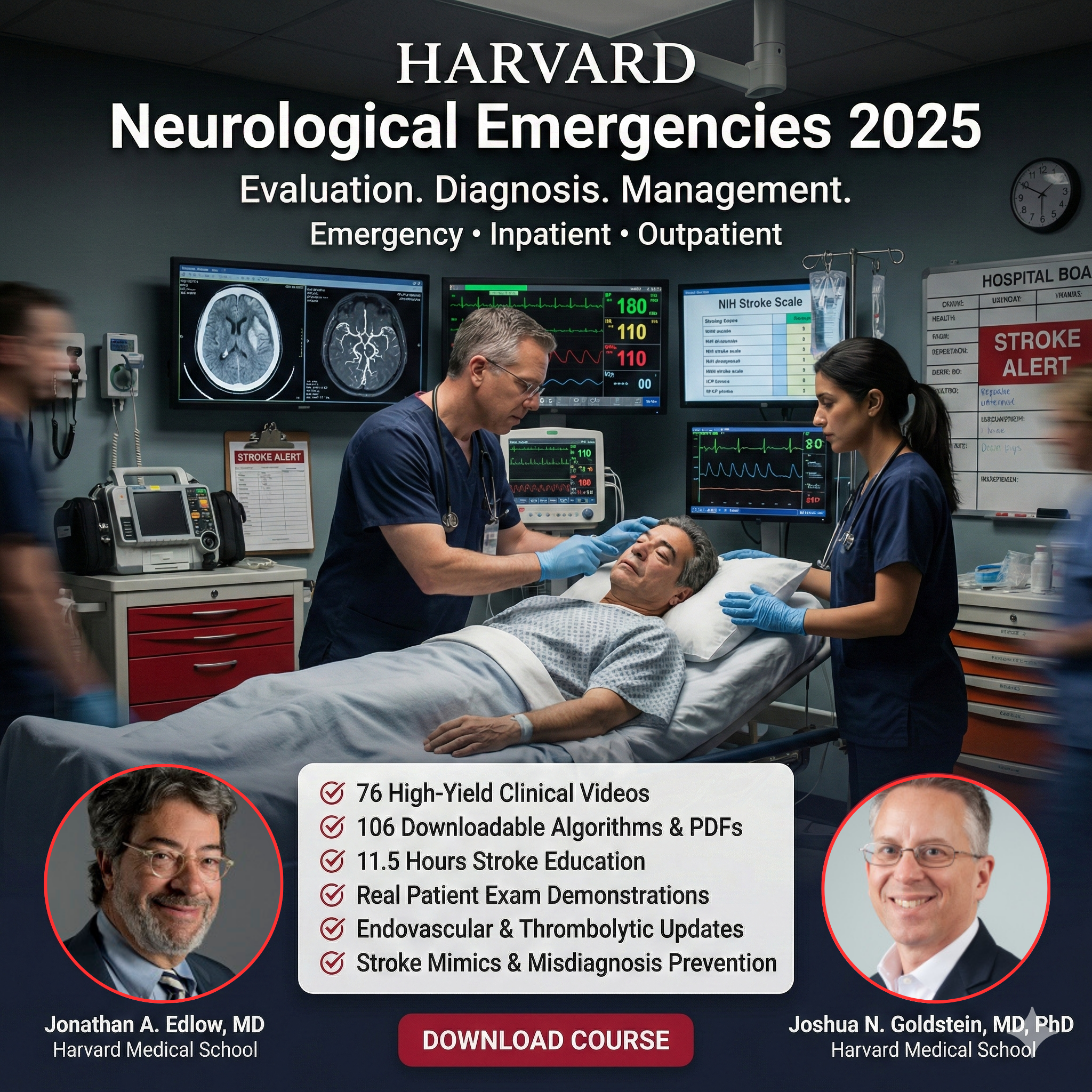
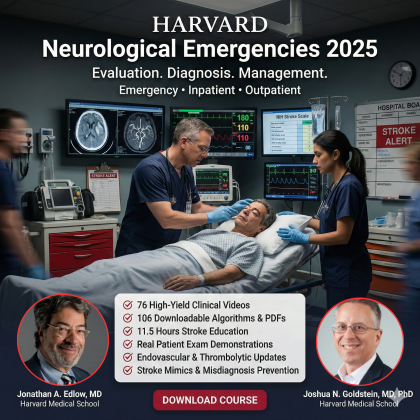
Neurological Emergencies 2025
Stroke · TIA · Seizures · Headache · Dizziness · TBI · Spinal Emergencies
A comprehensive clinical course focused on rapid recognition, diagnostic strategy, early action, and current management of time-sensitive neurological presentations across emergency, inpatient, and outpatient settings.
Recognize neurological emergencies faster and act earlier
Neurological emergencies demand efficient assessment, accurate diagnosis, and rapid treatment decisions. This course focuses on practical approaches to high-frequency neurological complaints and high-risk neurological conditions.
The program reviews clinical reasoning, focused neurological examination, neuroimaging, stroke care, seizures, traumatic brain injury, spinal emergencies, altered mental status, dizziness, headache, and other urgent presentations.
The course also addresses diagnostic error, misdiagnosis, imaging limitations, and strategies to improve patient safety.
- Rapidly identify neurological emergencies and high-risk presentations
- Optimize the neurological history and focused physical examination
- Choose CT, CTA, CTP, MRI, MRA, and other diagnostic tests more effectively
- Review modern stroke, seizure, TBI, ICH, and spinal emergency management
- Reduce diagnostic error and improve patient safety
Why This Course Matters
Build a clearer framework from the first neurological complaint to diagnosis, treatment, and escalation.
Improve early recognition
Review practical approaches to headache, dizziness, weakness, back pain, altered mental status, seizures, and other common emergency presentations.
Use diagnostics more effectively
Understand when to use CT, CTA, CTP, MRI, MRA, POCUS, laboratory testing, and focused bedside examination.
Manage high-risk conditions
Review ischemic stroke, TIA, intracerebral hemorrhage, cerebral aneurysm, TBI, seizures, spinal cord compression, cauda equina syndrome, and coma.
Reduce diagnostic error
Strengthen recognition of stroke mimics, functional neurologic disorders, imaging pitfalls, posterior circulation stroke, and other commonly missed presentations.
11.5 Hours Dedicated to Stroke
A major portion of the program focuses on modern stroke diagnosis and management.
State-of-the-Art Stroke Management
Topics include acute ischemic stroke, TIA, thrombolytics, endovascular therapy, advanced imaging, carotid stenosis, intracerebral hemorrhage, stroke mimics, arterial dissections, and posterior circulation stroke.
Complete 3-Day Course Schedule
Open each day to review the lectures, keynotes and breakout sessions.
Day 1 — Evaluation, Imaging & Early Management October 22, 2025
Lectures, keynotes and breakout sessions from the complete course schedule.
-
Jonathan A. Edlow, MD, FACEP and Joshua N. Goldstein, MD, PhD
7:50am – 8:00am
Welcome and Introduction
-
Christopher S. Ogilvy, MD
8:00am – 9:00am
Cerebral Aneurysms: 2025 Update
-
William A. Copen, MD
9:15am – 10:00am
Neuroimaging 101
-
Jonathan A. Edlow, MD, FACEP
10:15am – 10:45am
Back Pain 2025: Red Flags and Beyond
-
William A. Copen, MD
11:15am – 11:45am
Neuroimaging of the Spine: What to Order and How to Read
-
Ganesh Shankar, MD, PhD
12:00pm – 12:30pm
Updates in Urgent Management of Spinal Cord and Cauda Equina Disorders
-
William A. Copen, MD
1:45pm – 2:30pm
Neuroimaging in Stroke
-
Maura Kennedy, MD and Eyal Y. Kimchi, MD, PhD
1:45pm – 2:30pm
Altered Mental Status: Case Studies
-
Andrea G. Edlow, MD, MSc
2:30pm – 3:15pm
Acute Pregnancy-Related Neurological Disorders
-
Shan W. Liu, MD, SD
2:30pm – 3:15pm
Gait Disturbance and Falls
-
Joshua N. Goldstein, MD, PhD
3:15pm – 4:00pm
Intracerebral Hemorrhage
-
Ludy Shih, MD, MMSc
3:15pm – 4:00pm
Recognizing and Managing Complications of Parkinson's Disease
-
Sara Finkelstein, MD, MSc
4:15pm – 4:45pm
Functional Neurological Disorders: How to Diagnose and How to Treat
Day 2 — Stroke, Seizures & High-Risk Conditions October 23, 2025
Lectures, keynotes and breakout sessions from the complete course schedule.
-
Thanh Nguyen, MD
8:00am – 8:45am
State of the Art in Endovascular Therapy
-
Joshua N. Goldstein, MD, PhD
9:00am – 9:30am
Acute Stroke 2025: IV Thrombolytics
-
Matthew S. Siket, MD, MSc, FACEP
9:45am – 10:15am
TIA in 2025: What to Do and When to Do It
-
Nicole Dubosh, MD
10:45am – 11:15am
Diagnosing Subarachnoid Hemorrhage: Whom to Image? Whom to LP?
-
Nicole Dubosh, MD
11:30am – 12:00pm
SAH Management
-
Marc A. Bouffard, MD
1:15pm – 2:00pm
Acute Visual Loss
-
Sandeep Kumar, MD
1:15pm – 2:00pm
Stroke Management: Beyond Revascularization
-
Evie Marcolini, MD, FACEP, FCCM
2:00pm – 2:45pm
Seizures and Epilepsy: Updates in Treatment
-
Sandeep Kumar, MD
2:00pm – 2:45pm
Carotid Stenosis: When to Intervene and How
-
Evie Marcolini, MD, FACEP, FCCM
2:45pm – 3:30pm
Meningitis and Encephalitis
-
Rebecca C. Burch, MD
2:45pm – 3:30pm
Managing Difficult Headaches
-
Jonathan A. Edlow, MD, FACEP
3:45pm – 4:45pm
Headache Causes You Cannot Miss: Red Flags and How to Use Them
Day 3 — Dizziness, TBI & Diagnostic Error October 24, 2025
Lectures, keynotes and breakout sessions from the complete course schedule.
-
David Greer, MD
8:00am – 9:00am
Neuroprognostication After Cardiac Arrest, and Brain Death
-
Jonathan A. Edlow, MD, FACEP
9:15am – 10:00am
Dizziness 2025: The Evidence-Based Approach—with Video Evaluations of Real Patients
-
Jonathan A. Edlow, MD, FACEP
10:30am – 11:15am
Diagnosing and Treating BPPV: Have More Fun in Your Practice!
-
Rebekah Mannix, MD, MPH
11:30am – 12:00pm
Concussions
-
Jonathan A. Edlow, MD, FACEP
1:15pm – 2:00pm
Acute Generalized Weakness
-
MingMing Ning, MD, MMSc
1:15pm – 2:00pm
Arterial Dissections
-
Onyinyechi Eke, MD
2:00pm – 2:45pm
POCUS on the Brain: Point-of-Care Ultrasound for Neurologic Evaluation
-
Aneesh Singhal, MD
2:00pm – 2:45pm
Cerebral Venous Thrombosis: Updates and New 2025 Guidelines
-
Brian L. Edlow, MD
2:45pm – 3:30pm
Traumatic Brain Injury
-
Aneesh Singhal, MD
2:45pm – 3:30pm
Reversible Cerebral Vasoconstriction Syndrome: How to Diagnose and Treat This Underdiagnosed Cause of Acute Severe Headache
-
Jonathan A. Edlow, MD, FACEP
3:45pm – 4:30pm
The Psychology of Diagnostic Errors: A Clinician’s Perspective
-
Jonathan A. Edlow, MD, FACEP and Joshua N. Goldstein, MD, PhD
4:45pm – 5:00pm
Course Wrap-Up, Q&A
Practical neurological emergency care across settings
The course connects evaluation, diagnosis, treatment, and risk reduction.
Evaluation
Headache, dizziness, weakness, altered mental status, back pain, gait disturbance, and focused neurological examination.
Diagnostics
Neuroimaging, CT/CTA/CTP, MRI/MRA, POCUS, bedside testing, and diagnostic strategy.
Management
Stroke, TIA, seizures, TBI, ICH, aneurysm, spinal cord compression, cauda equina syndrome, and acute visual loss.
Risk Reduction
Misdiagnosis, diagnostic error, risk mitigation, stroke mimics, functional neurological disorders, and patient safety.
Learning focus and intended audience
Designed for clinicians who encounter neurological symptoms and emergencies across emergency, inpatient, and outpatient care.
Key Learning Areas
- Rapidly identify neurological emergencies and act early.
- Improve the neurological history and focused physical examination.
- Use neuroimaging more effectively and understand its limitations.
- Recognize stroke mimics and other diagnostic pitfalls.
- Apply current management strategies for stroke, seizures, TBI, ICH, aneurysm, and spinal emergencies.
- Improve patient safety and reduce diagnostic error.
Who Should Participate
The course is designed for physicians, nurse practitioners, and physician assistants across acute and general care specialties.
Course Directors
Leadership in emergency medicine and neurological emergencies.
Professor of Medicine and Emergency Medicine, Harvard Medical School; Department of Emergency Medicine, Beth Israel Deaconess Medical Center.
Professor of Emergency Medicine, Harvard Medical School; Director, Center for Neurologic Emergencies, Department of Emergency Medicine, Mass General Brigham.
Course Faculty
Faculty span emergency medicine, neurology, neurosurgery, stroke, neuroradiology, critical care, and related fields.
Marc A. Bouffard, MD
Assistant Professor of Neurology, Harvard Medical School
William A. Copen, MD
Department of Radiology, Massachusetts General Hospital
Nicole Dubosh, MD
Director of Undergraduate Medical Education, Beth Israel Deaconess Medical Center (BIDMC); Medical Education Fellowship Director, BIDMC; Director of Education Research, Department of Emergency Medicine, BIDMC; Associate Professor of Emergency Medicine, Harvard Medical School
Andrea G. Edlow, MD, MSc
Division of Maternal-Fetal Medicine, Massachusetts General Hospital: Associate Professor of Obstetrics, Gynecology, and Reproductive Biology, Harvard Medical School; Investigator, Vincent Center for Reproductive Biology
Brian L. Edlow, MD
Neurocritical Care Faculty, Massachusetts General Hospital; Co-Director, Mass General Neuroscience; Associate Director, Center for Neurotechnology and Neurorecovery; Affiliated Faculty, Athinoula A. Martinos Center for Biomedical Imaging; Associate Professor of Neurology, Harvard Medical School; Chen Institute MGH Research Scholar 2023-2028
Onyinyechi Eke, MD
Director, Global Ultrasound, Massachusetts General Hospital (MGH); Attending Physician, Department of Emergency Medicine, MGH; Assistant Professor of Emergency Medicine, Harvard Medical School
Sara Finkelstein, MD, MSc
Attending Physician and Associate Director, Functional Neurological Disorder Unit, Massachusetts General Hospital; Instructor in Neurology, Harvard Medical School
Maura Kennedy, MD
Division Chief, Geriatric Emergency Medicine, Massachusetts General Hospital; Associate Professor of Emergency Medicine, Harvard Medical School
Sandeep Kumar, MD
Attending Physician, Department of Neurology, Stroke Division, Beth Israel Deaconess Medical Center; Associate Professor of Neurology, Harvard Medical School
Shan W. Liu, MD, SD
Director, Geriatric Emergency Medicine Division Fellowship; Attending Physician, Department of Emergency Medicine, Massachusetts General Hospital; Associate Professor of Emergency Medicine, Harvard Medical School; Past-President, Academy of Geriatric Emergency Medicine
Rebekah Mannix, MD, MPH
Chief, Division of Emergency Medicine, Boston Children's Hospital; Professor of Pediatrics, Associate Professor of Emergency Medicine, Harvard Medical School
MingMing Ning, MD, MMSc
Director, Cardio-Neurology Clinic; Director, Clinical Proteomics Research Center, Massachusetts General Hospital; Associate Professor of Neurology, Harvard Medical School
Christopher S. Ogilvy, MD
Director, Endovascular and Operative Neurovascular Surgery, Beth Israel Deaconess Medical Center Brain Aneurysm Institute; Professor of Neurosurgery, Harvard Medical School
Ganesh Shankar, MD, PhD
Director of Spine Neurosurgery, Massachusetts General Hospital; Co-Director, Mass General Brigham Neurosurgery Spine Fellowship; Associate Professor of Neurosurgery, Harvard Medical School
Ludy Shih, MD, MMSc
Clinical Director, Parkinson’s Disease and Movement Disorders Center, Department of Neurology, Beth Israel Deaconess Medical Center; Member of the Faculty (appointment pending), Harvard Medical School
Aneesh Singhal, MD
Vice Chair of Neurology & Quality and Safety, Massachusetts General Hospital (MGH); Director, MGH Comprehensive Stroke Center; Co-Chair, Mass General Brigham Stroke Collaborative; Associate Professor of Neurology, Harvard Medical School
Rebecca C. Burch, MD
Assistant Professor, Neurological Sciences, University of Vermont Medical Center
Ali Daneshmand, MD, MPH
Assistant Professor of Neurology and Neurosurgery, Boston University School of Medicine
David Greer, MD
Chief, Department of Neurology, Boston Medical Center; Professor and Chair, Department of Neurology, Boston University School of Medicine
Eyal Yaacov Kimchi, MD, PhD
Assistant Professor of Neurology, Feinberg School of Medicine, Northwestern University
Evie Marcolini, MD, FACEP, FCCM
Associate Professor of Emergency Medicine and Neurology, Geisel School of Medicine at Dartmouth; Vice Chair of Faculty Affairs, Department of Emergency Medicine, Geisel School of Medicine at Dartmouth
Thanh Nguyen, MD
Director, Interventional Neuroradiology and Interventional Neurology, Boston Medical Center; Professor of Neurology, Neurosurgery and Radiology, Boston University School of Medicine
Matthew S. Siket, MD, MSc, FACEP
Associate Program Director, UVM Emergency Medicine Residency Program; Associate Professor, Department of Emergency Medicine; Robert Larner M.D. College of Medicine at the University of Vermont
Build confidence in time-sensitive neurological decisions
Review the complete course across evaluation, diagnosis, imaging, stroke, seizures, TBI, spinal emergencies, dizziness, headache, and diagnostic error.
Download Course







Reviews
There are no reviews yet.