Master the Clinical Reasoning Behind EMG & Neuromuscular Diagnosis
Build a stronger framework for interpreting electrodiagnostic findings and approaching complex neuropathies, motor neuron disease, neuromuscular junction disorders, myopathies and challenging weakness presentations.

A patient presents with weakness.
An Abnormal EMG Doesn't Automatically Give You the Diagnosis.
Electrodiagnostic testing is only one part of the clinical picture. The difficult part is connecting symptoms, neurological examination, nerve conduction findings, needle EMG and the differential diagnosis.
When weakness, neuropathy, radiculopathy, plexopathy, neuromuscular junction dysfunction and muscle disease overlap, a structured diagnostic framework becomes essential.
Go Beyond Memorizing Waveforms
Develop a broader understanding of electrodiagnostic techniques and how they apply across complex neuromuscular presentations.
Nerve Conduction Studies
Review sensory and motor nerve conduction principles and their diagnostic applications.
Needle EMG
Explore spontaneous activity, voluntary motor unit activity and interpretation of clinically relevant findings.
Clinical Localization
Strengthen your approach to mononeuropathies, plexopathies, radiculopathies and multifocal weakness.
Motor Neuron Disease
Review ALS, atypical motor neuron disorders and spinal muscular atrophy.
Polyneuropathies
Cover CMT, Guillain-Barré syndrome, CIDP, systemic, cancer-associated and toxic neuropathies.
Muscle & NMJ Disorders
Explore myasthenia gravis, myopathies, muscular dystrophies, channelopathies and metabolic disorders.
From Complex Presentation to Clearer Clinical Reasoning
Work through neuromuscular problems using a more systematic diagnostic framework.
Designed for Clinicians Working With Neuromuscular Disease
Whether you're strengthening foundational knowledge or refreshing advanced concepts, the curriculum spans both diagnostic techniques and clinical disease.
Neurologists
Deepen your approach to electrodiagnosis and challenging neuromuscular presentations.
PM&R Physicians
Strengthen knowledge of EMG, NCS, focal neuropathy and neuromuscular rehabilitation.
Residents
Build a structured foundation across major electrodiagnostic and neuromuscular topics.
Fellows
Consolidate advanced concepts across a broad, clinically-focused curriculum.
Learn From Leaders in Neuromuscular Medicine
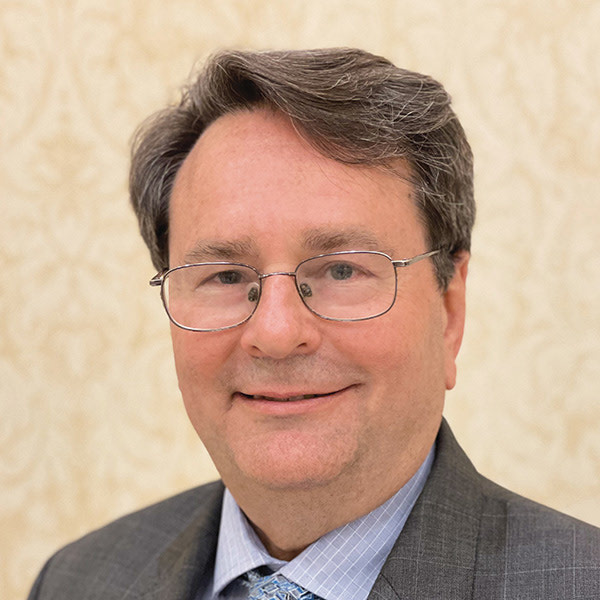
Anthony A. Amato, MD
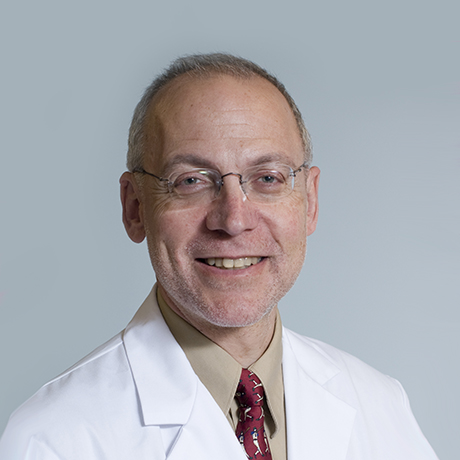
William S. David, MD, PhD
Build a Stronger Neuromuscular Diagnostic Framework
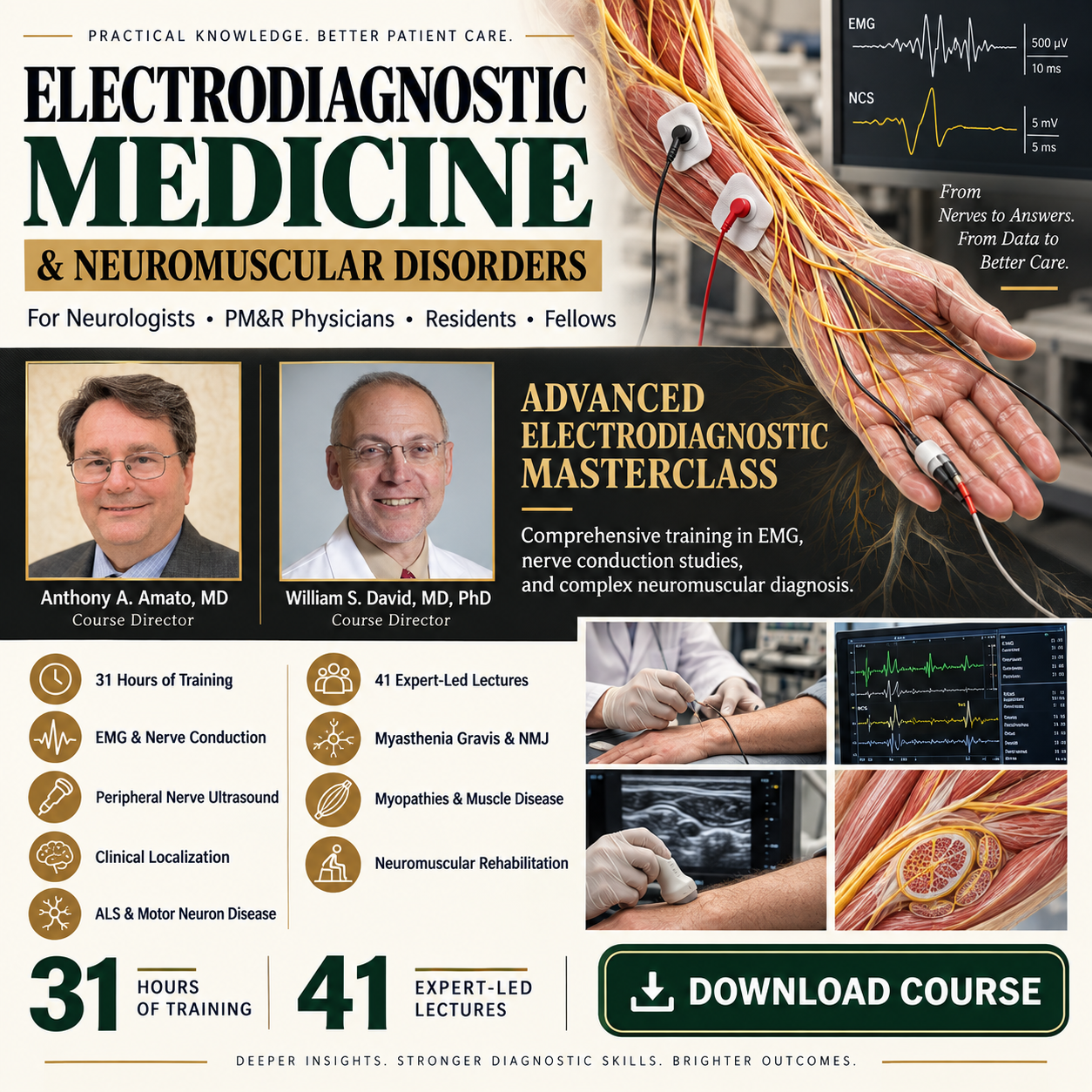
Access all 41 expert-led lectures in one comprehensive program.
What's Inside the Course?
A broad curriculum spanning foundational electrodiagnostic techniques through complex neuromuscular disorders.
01
Basic Neurophysiological Techniques
+
- Sensory Nerve Conduction Studies
- Motor Nerve Conduction Studies
- EMG — Spontaneous Activity
- Needle EMG — Voluntary Activity
- Repetitive Stimulation & Single Fiber EMG
- Autonomic Function Testing
02
Clinical Applications: Focal Syndromes
+
- Upper Extremity Mononeuropathies
- Brachial Plexopathies
- Focal Mononeuropathies in the Leg
- Lower Limb Radiculopathy and Plexopathy
- Peripheral Nerve Ultrasound
03
Generalized Disorders
+
- Generalized Weakness
- Multifocal Weakness
- Scapular Winging
- Diplopia
- Facial Weakness
- Clinical Myotonia
- Muscle Cramps
04
Motor Neuron Diseases
+
- Amyotrophic Lateral Sclerosis
- Atypical Motor Neuron Diseases
- Spinal Muscular Atrophy
05
Polyneuropathies
+
- Approach to Neuropathies
- Charcot-Marie-Tooth and Related Disorders
- Guillain-Barré and Acute Acquired Neuropathies
- CIDP and Related Disorders
- Neuropathies Associated with Systemic Disease and Cancer
- Toxic Polyneuropathies
06
Myopathies & Neuromuscular Junction Disorders
+
- Myasthenia Gravis
- Lambert-Eaton Syndrome and Botulism
- Clinical Approach to Muscle Disease
- Muscular Dystrophies
- Congenital Myopathies
- Metabolic & Mitochondrial Myopathies
- Muscle Channelopathies
- Idiopathic Inflammatory Myopathies
- Rhabdomyolysis
07
Special Topics
+
- Neonatal Hypotonia
- Neuromuscular Mimics
- Rehabilitation of Neuromuscular Disorders
Stop Piecing Together Neuromuscular Knowledge From Scattered Resources
Bring electrodiagnostic fundamentals and major neuromuscular disorders together in one structured learning program.
Is This Course Right for You?
I already know the basics of EMG. Will this still be useful?
The curriculum extends beyond basic electrodiagnostic techniques into clinical applications involving focal neuropathies, plexopathies, radiculopathies, ALS, polyneuropathies, neuromuscular junction disorders, myopathies and complex weakness presentations.
I don't see neuromuscular patients every day. Is it still relevant?
A broad structured review can be particularly useful when challenging neuromuscular presentations arise less frequently in your practice and you want to refresh patterns, testing approaches and differential diagnosis.
Do I need to watch all 31 hours in order?
The course covers multiple topic areas, so you can work through the curriculum systematically or focus first on the subjects most relevant to your learning needs.
Who is the program designed for?
The material is particularly relevant to neurologists, physical medicine and rehabilitation physicians, residents and fellows interested in electrodiagnostic and neuromuscular medicine.
Electrodiagnostic Medicine & Neuromuscular Disorders
Strengthen your understanding of electrodiagnostic techniques while exploring the major disorders behind complex neuromuscular presentations.
Ready to Start?
Get access to the complete Electrodiagnostic Medicine & Neuromuscular Disorders program.
DOWNLOAD COURSE →




Reviews
There are no reviews yet.