
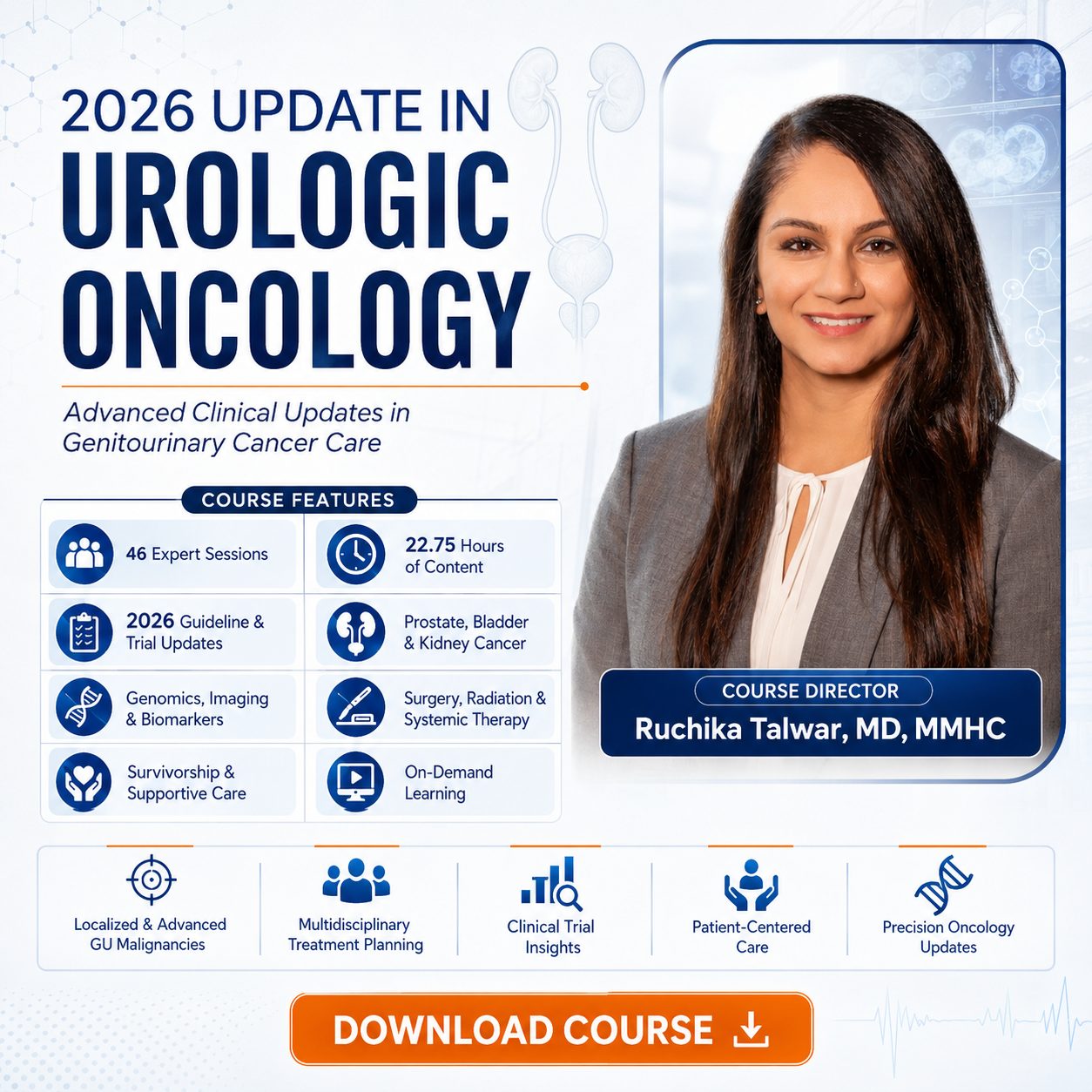
2026 Update in Urologic Oncology
Prostate · Bladder · Kidney · Germ-Cell · Penile · Adrenal Cancers
Strengthen your approach to genitourinary cancer care with a focused curriculum covering new guidelines, recent trials, precision diagnostics, advanced imaging, systemic therapies, survivorship, and multidisciplinary decision-making.
Translate rapidly changing GU oncology evidence into better clinical decisions
Genitourinary oncology increasingly requires clinicians to combine disease-specific guidelines with genomic information, advanced imaging, new systemic therapies, surgical innovation, and individualized survivorship planning.
This comprehensive course brings those areas together through expert-led sessions spanning prostate, bladder, kidney, urothelial, germ-cell, penile, pediatric, and adrenal oncology.
The curriculum emphasizes practical diagnosis, treatment sequencing, multidisciplinary coordination, patient-centered care, and the translation of emerging evidence into everyday clinical workflows.
- Review current guidelines and pivotal clinical-trial evidence
- Integrate biomarkers, genomics, and advanced imaging into care
- Sequence surgery, systemic therapy, and radiation appropriately
- Improve management of localized and advanced GU malignancies
- Strengthen survivorship, sexual health, and supportive care planning
Why This Course Matters
Move beyond fragmented updates and build a more complete clinical framework.
Each topic focuses on a real diagnostic, treatment, sequencing, or survivorship challenge encountered across modern genitourinary cancer care.
Navigate prostate cancer care
Review PSA screening, biopsy, genomic risk assessment, surveillance, surgery, radiation, focal therapy, recurrence, and systemic treatment.
Clarify bladder cancer decisions
Connect hematuria workup, NMIBC risk stratification, perioperative therapy, cystectomy, urinary diversion, and bladder-preservation strategies.
Manage renal masses confidently
Compare advanced imaging, surveillance, open and robotic surgery, radiation, cytoreductive nephrectomy, and systemic RCC therapy.
Improve whole-patient cancer care
Address sexual health, frailty, smoking cessation, enhanced recovery, palliative care, adverse effects, and treatment-related quality-of-life concerns.
Complete Urologic Oncology Curriculum
Open each clinical module to review its sessions and expert faculty.
Foundations, Screening and Risk Assessment 6 sessions
-
Aaron Laviana, MD, MBA
Foundations
Understanding the Global Epidemiology and Burden of Genitourinary Cancers
-
Kristian Stensland, MD, MPH, MS
Evidence
Clinical Trial Design and Interpretation for the Busy Surgeon
-
Udit Singhal, MD
Prostate Screening
Contemporary PSA-Based Screening for Prostate Cancer — Evidence, Controversies, and Risk-Adapted Approach
-
Kara Watts, MD
Diagnosis
Prostate Biopsy — Techniques, Pitfalls, and Future Directions
-
Randy A. Vince, Jr., MD, MS
Genomics
Genomic Classifiers Part 1 — Prostate Cancer Screening Risk Assessment
-
Randy A. Vince, Jr., MD, MS
Genomics
Genomic Classifiers Part 2 — Prostate Cancer Risk Stratification
Localized and Advanced Prostate Cancer 10 sessions
-
Kristen R. Scarpato, MD, MPH
Localized Disease
Active Surveillance in Prostate Cancer
-
Keith J. Kowalczyk, MD
Surgery
Robotic-Assisted Radical Prostatectomy — Novel Techniques
-
Khush Singh Aujla, MD, MHA
Radiation
Radiation Therapy for Prostate Cancer — Low- and Intermediate-Risk Categories
-
Khush Singh Aujla, MD, MHA
Radiation
Radiation Therapy for Prostate Cancer — High-Risk Localized and Locally Advanced Categories
-
Kara Watts, MD
Focal Therapy
Focal Therapy for Prostate Cancer
-
Niels V. Johnsen, MD, MPH, FACS
Survivorship
Principles of Prostate Cancer Survivorship after Radical Prostatectomy — Erectile Dysfunction and Urinary Incontinence
-
Mohummad Minhaj Siddiqui, MD, FACS
Recurrence
Oligometastatic and Biochemical Recurrence of Prostate Cancer
-
Catherine Fahey, MD, PhD
Systemic Therapy
Management of Advanced Prostate Cancer for the Urologist — Part 1: De Novo Locally Advanced Systemic Therapy
-
Catherine Fahey, MD, PhD
Systemic Therapy
Management of Advanced Prostate Cancer for the Urologist — Part 2: De Novo Metastatic Systemic Therapy
-
Cameron J. Britton, MD
Quality of Life
Managing Treatment-Related Adverse Effects, Sexual Health, and Survivorship after Prostate Cancer Treatment
Bladder and Upper-Tract Urothelial Cancer 8 sessions
-
Mary Beth Westerman, MD
Diagnosis
Contemporary Workup of Microscopic and Gross Hematuria
-
Helen Y. Hougen, MD
NMIBC
Non-Muscle-Invasive Bladder Cancer Part 1 — Diagnosis and Risk Stratification
-
Helen Y. Hougen, MD
NMIBC
Non-Muscle-Invasive Bladder Cancer Part 2 — Treatments
-
Parminder Singh, MD
MIBC
Neoadjuvant Chemotherapy Prior to Radical Cystectomy for Muscle-Invasive Bladder Cancer
-
Parminder Singh, MD
MIBC
Adjuvant Therapy for Muscle-Invasive Bladder Cancer
-
Laura Bukavina, MD, MPH, MSc
Surgery
Radical Cystectomy for Muscle-Invasive Bladder Cancer — Surgical Approaches and Urinary Diversions
-
Wesley Yip, MD
Bladder Preservation
Trimodality Bladder-Preservation Protocols for MIBC
-
Amy Luckenbaugh, MD, FACS
Upper Tract
Upper-Tract Urothelial Carcinoma — Diagnosis and Treatment
Kidney Cancer and Renal Masses 8 sessions
-
Ava Saidian, MD
Imaging
Novel Imaging Strategies in Renal Mass Staging and Detection
-
Daniel D. Shapiro, MD, FACS
Small Renal Masses
Management of Small Renal Masses
-
Kelvin A. Moses, MD, PhD, FACS
Open Surgery
Surgical Approaches for Renal Masses — Overview of Open Surgery and Anatomical Considerations
-
Daniel D. Joyce, MD, MS
Robotic Surgery
Small Renal Masses — Overview of Robotic Approaches
-
Vidit Sharma, MD, MS
Advanced RCC
Advanced RCC — Venous Tumor Thrombi and Cytoreductive Nephrectomy
-
Dakim Gaines, MD, PhD
Radiation
Renal Cell Carcinoma — Implications for Radiation Therapy
-
Katy Beckermann, MD, PhD
Systemic Therapy
The Systemic Therapy Landscape for RCC
-
Allison May, MD
Hereditary Disease
Non-Clear-Cell Renal Masses and Hereditary RCC Syndromes
Germ-Cell and Penile Cancers 4 sessions
-
Daniel D. Joyce, MD, MS
Germ-Cell Cancer
Early-Stage Germ-Cell Tumors — Management Approaches
-
Nirmish Singla, MD, MSCS, FACS
Germ-Cell Cancer
Metastatic Germ-Cell Cancer — Management Approaches
-
Reza Nabavizadeh, MD
Penile Cancer
Penile Cancer Part 1 — Organ-Confined Disease
-
Reza Nabavizadeh, MD
Penile Cancer
Penile Cancer Part 2 — Advanced Disease
Supportive Care, Innovation and Special Populations 8 sessions
-
Saum B. Ghodoussipour, MD
Recovery
Enhanced Recovery After Surgery
-
Kristen R. Scarpato, MD, MPH
Palliative Care
Palliative and End-of-Life Care — Integrating Early with Curative-Intent Pathways
-
Abhinav Khanna, MD
Innovation
Artificial Intelligence Applications for GU Cancers
-
Ariana L. Smith, MD
Sexual Health
Optimizing Sexual Health in Women Undergoing Radical Cystectomy
-
Leslie M. Peard, MD
Pediatrics
Pediatric Urologic Oncology
-
Logan Briggs, MD
Frailty
Frailty Assessments in GU Cancer Patients
-
Marshall Strother, MD
Adrenal Disease
Diagnosis and Management of Benign Adrenal Lesions
-
Jacob Tallman, MD
Adrenal Disease
Malignant Adrenal Masses for the Urologist
Prevention and Robotic Performance 2 sessions
-
Marc Bjurlin, DO, MSc
Prevention
Smoking Cessation in Genitourinary Cancer Care
-
Janet Kukreja, MD, MPH, FACS
Robotic Surgery
Optimizing Performance and Efficiency in Robotic-Assisted Procedures
A multidisciplinary review across the major areas of GU cancer care
Each track connects diagnosis, treatment selection, sequencing, and survivorship.
Prostate Cancer
Screening, biopsy, genomics, active surveillance, surgery, radiation, focal therapy, recurrence, systemic treatment, and survivorship.
Bladder & Urothelial
Hematuria evaluation, NMIBC, MIBC, chemotherapy, cystectomy, urinary diversion, bladder preservation, and upper-tract disease.
Kidney & RCC
Renal mass imaging, small renal masses, open and robotic surgery, advanced RCC, radiation, systemic therapy, and hereditary syndromes.
Special Topics
Germ-cell and penile cancers, adrenal lesions, pediatric oncology, AI, frailty, palliative care, sexual health, and robotic performance.
Learning objectives, audience and course leadership
A practical update for clinicians involved in genitourinary cancer diagnosis, treatment and multidisciplinary care.
Learning Objectives
Upon completion of this activity, you should be able to:
- Interpret the latest NCCN/AUA guideline updates and pivotal trial data to optimize management of localized and advanced genitourinary malignancies.
- Integrate imaging, genomic, molecular, and biomarker information into personalized diagnostic and treatment algorithms.
- Formulate multidisciplinary treatment plans that appropriately sequence surgery, systemic therapy, radiation, and survivorship strategies.
- Apply evidence-based multidisciplinary and survivorship strategies to improve quality and coordination of care in genitourinary oncology.
- Evaluate emerging therapies, clinical-trial data, and evolving standards of care relevant to genitourinary oncology practice.
Who Should Participate
This activity was designed for urologists, urologic oncologists, and medical oncologists. It may also be valuable for radiation oncologists, oncology fellows, advanced practice clinicians, and other healthcare professionals involved in GU cancer care.

Assistant Professor
Department of Urology
Medical Director, Episodes of Care, Population Health
Division of Urologic Oncology
Vanderbilt University Medical Center
Nashville, TN
Meet the course director and expert faculty
A multidisciplinary teaching team from leading academic and cancer centers.
Khush Singh Aujla, MD, MHA
Assistant Professor
Department of Radiation Oncology: Genitourinary Service Line
Vanderbilt University Medical Center
Nashville, TN
Katy Beckermann, MD, PhD
Medical Director, GU Clinical Research
Tennessee Oncology, Greco-Hainsworth Center for Research
Nashville, TN
Marc A. Bjurlin, DO, MSc
Associate Professor
Director of Clinical Trials
Vice Chair of Research
Lineberger Comprehensive Cancer Center
Department of Urology
University of North Carolina
Chapel Hill, NC
Logan Briggs, MD
Department of Urology
Mayo Clinic of Arizona
Scottsdale, AZ
Cameron J. Britton, MD
Department of Urologic Oncology
Vanderbilt University Medical Center
Nashville, TN
Laura Bukavina, MD, MPH, MSc
Glickman Urologic Institute
Cleveland Clinic
Cleveland, OH
Catherine Fahey, MD, PhD
Assistant Professor
Division of Oncology
University of North Carolina at Chapel Hill
Chapel Hill, NC
Dakim Gaines, MD, PhD
Assistant Professor
Department of Radiation Oncology
Vanderbilt University Medical Center
Nashville, TN
Saum B. Ghodoussipour, MD
Associate Professor
Department of Surgery
Director, Bladder and Urothelial Cancer Program
Section of Urologic Oncology
Rutgers Cancer Institute
Rutgers Robert Wood Johnson Medical School
New Brunswick, NJ
Helen Y. Hougen, MD
Department of Urologic Oncology
University of Iowa Health Care
Iowa City, IA
Niels V. Johnsen, MD, MPH, FACS
Department Of Urology
Vanderbilt University Medical Center
Nashville, TN
Daniel D. Joyce, MD, MS
Assistant Professor
Department of Urology
Vanderbilt University Medical Center
Nashville, TN
Abhinav Khanna, MD
Assistant Professor
Mayo Clinic
Rochester, MN
Keith J. Kowalczyk, MD
Chair, Department of Urology
Georgetown University Medical Center
MedStar Georgetown University Hospital
Washington, DC
Janet Kukreja, MD, MPH, FACS
Associate Professor
University of Colorado
Aurora, CO
Aaron A. Laviana, MD, MBA
Assistant Professor
Department of Surgery and Perioperative Care
Courtesy Faculty Member, Department of Oncology
The University of Texas at Austin Dell Medical School
Austin, TX
Amy Luckenbaugh, MD, FACS
Associate Professor
Department of Urology
Vanderbilt University Medical Center
Nashville, TN
Allison May, MD
Assistant Professor
Department of Urology
University of Virginia
Charlottesville, VA
Kelvin A. Moses, MD, PhD, FACS
Department Of Urology
Vanderbilt University Medical Center
Nashville, TN
Reza Nabavizadeh, MD
Assistant Professor
Division of Urologic Oncology
Department of Urology
Duke University
Durham, NC
Leslie Peard, MD
Assistant Professor
Department of Urology
University of Kentucky
Lexington, KY
Ava Saidian, MD
Assistant Professor
Department of Urologic Oncology
University of Tennessee-Memphis Health Science Center
Memphis, TN
Kristen R. Scarpato, MD, MPH
Associate Professor
Residency Program Director
Vice Chair of Education
Department of Urology
Division of Urologic Oncology
Vanderbilt University Medical Center
Nashville, TN
Daniel D. Shapiro, MD, FACS
Assistant Professor
Department of Urology
University of Wisconsin School of Medicine and Public Health
Madison, WI
Vidit Sharma, MD
Assistant Professor
Department of Urology
Mayo Clinic
Rochester, MN
Mohummad Minhaj Siddiqui, MD, FACS
Professor of Surgery and Chief of Urology
University of Maryland School of Medicine
Chief of Urology
Maryland VA Healthcare System
Baltimore, MD
Parminder Singh, MD
Consultant and Section Leader
Genitourinary Oncology
Associate Professor of Medicine
Department of Oncology (Medical)
Mayo Clinic Comprehensive Cancer Center
Mayo Clinic College of Medicine and Science
Mayo Clinic Arizona
Phoenix, AZ
Udit Singhal, MD
Assistant Professor
Department of Urologic Oncology
University of Michigan Rogel Cancer Center
Ann Arbor, MI
Nirmish Singla, MD, MSCS, FACS
Associate Professor
Departments of Urology and Oncology
Director, Translational Research in GU Oncology
Director, Kidney Cancer & UTUC Programs
Vice Chair, QSS, Brady Urological Institute
Johns Hopkins University School of Medicine
Baltimore, MD
Ariana L. Smith, MD
Alan J. Wein Professor of Urology
Chief of Urology
Pennsylvania Hospital
University of Pennsylvania
Philadelphia, PA
Kristian Stensland, MD, MPH, MS
Assistant Professor
Departments of Urology and Learning Health Sciences
University of Michigan
Ann Arbor, MI
Marshall Strother, MD
Assistant Professor
Oregon Health and Science University
Portland, OR
Jacob Tallman, MD
Assistant Professor
Department of Surgery
University of Chicago Medical Center
Chicago, IL
Randy A. Vince, Jr., MD, MS
Assistant Professor
Department of Urology
Director of Minority Men’s Health
University Hospitals Cleveland Medical Center
Seidman Cancer Center
Case Western Reserve University School of Medicine
Cleveland, OH
Kara Watts, MD
Associate Professor and Vice Chair
Department of Urology
Director, Urologic Cancer Services
Montefiore Medical Center
Bronx, NY
Mary Beth Westerman, MD
Associate Professor
Department of Urology
University of North Carolina
Chapel Hill, NC
Wesley Yip, MD
Assistant Professor of Urologic Oncology
Division of Urology
Department of Surgery
City of Hope
Duarte, CA
Build a more current and confident approach to GU cancer care
Study the complete 2026 curriculum and revisit the sessions most relevant to your clinical practice.
Download Course








9 reviews for 2026 Update in Urologic Oncology