
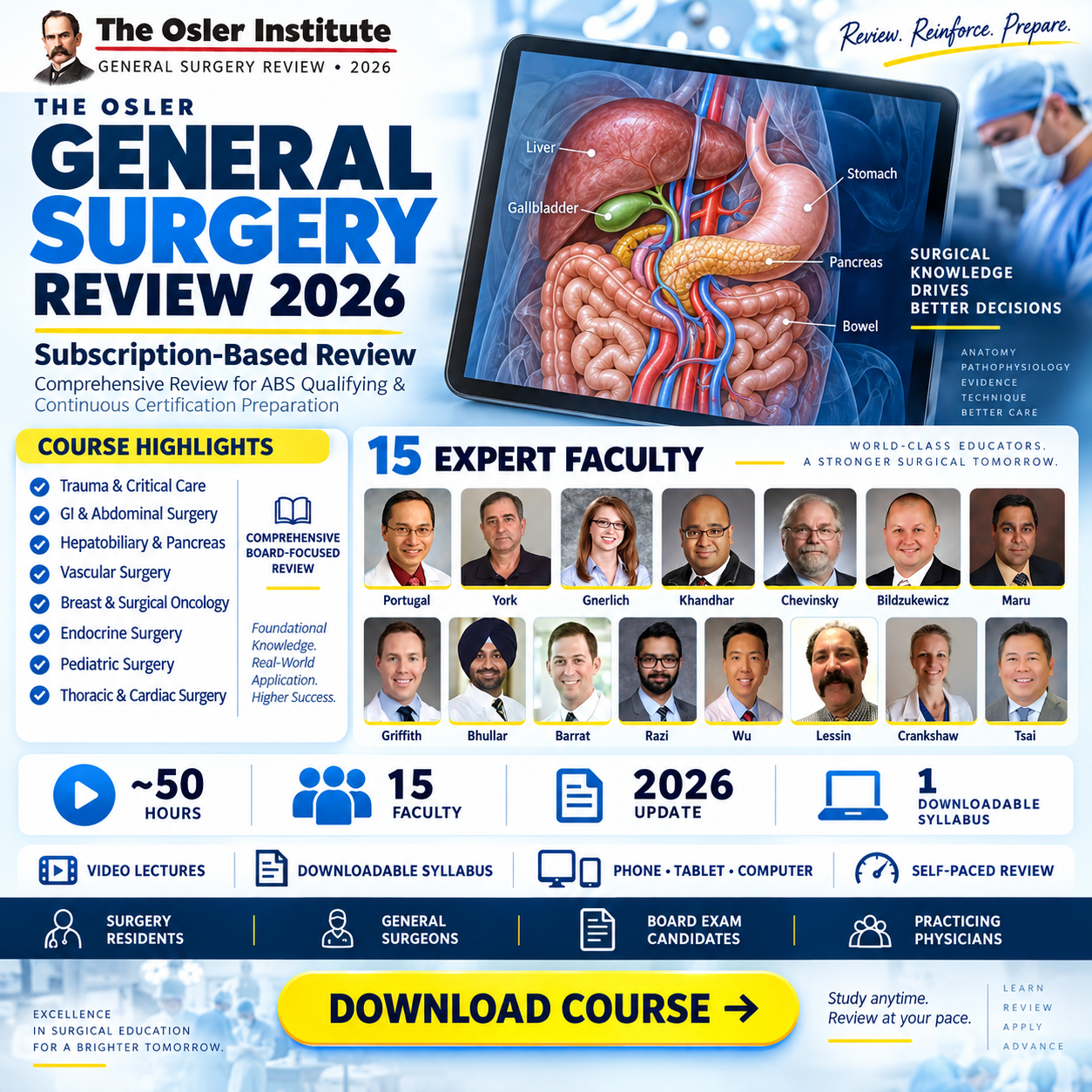
THE OSLER GENERAL SURGERY REVIEW
A comprehensive recorded review designed to strengthen your general surgery knowledge, reinforce board-relevant standards of care, and help you focus your study for the ABS Qualifying and Continuous Certification examinations.
Strengthen the Knowledge Behind Surgical Decisions
This comprehensive review brings together core surgical science, perioperative care, operative strategy, trauma, critical care, oncology, vascular disease, gastrointestinal surgery, endocrine surgery, and key specialty topics in one structured program.
Board-Relevant Review
Focus on evidence-based medicine, current standards of care, and high-yield concepts used throughout general surgery.
Full-Spectrum Coverage
Review preoperative, operative, postoperative, emergency, trauma, critical care, oncology, and specialty surgery topics.
Study on Your Schedule
Use the recorded lecture format to revisit difficult subjects, identify weak areas, and build a targeted self-study plan.
From Basic Science to Complex Surgical Care
The review is structured to connect foundational principles with practical patient management, helping learners revisit the clinical reasoning, operative approaches, and follow-up strategies used across major general surgery domains.
Core Areas Included
What You Should Be Able to Review and Apply
The program is designed to reinforce the major knowledge domains encountered in general surgery practice and examination preparation.
Summarize core basic-science principles that support patient management in general surgery.
Review preoperative, operative, and postoperative management across the principal components of general surgery.
Discuss perioperative principles relevant to cardiothoracic, pediatric, and transplant surgery.
Review common surgical problems involving urology, gynecology, orthopedics, and burns.
Reinforce tumor staging concepts and appropriate surgical and nonsurgical management strategies.
Recognize situations where non-operative management may be appropriate in general surgery patients.
Review newer diagnostic and therapeutic methods, including physiologic testing, vascular techniques, and ultrasonography.
Identify knowledge gaps that deserve additional focused study before examination or clinical application.
Learn Across the Major Areas of Surgery
The 2026 review brings together faculty covering general surgery, trauma, oncology, vascular, thoracic, pediatric, endocrine, colorectal, and related disciplines.















A Broad, Board-Oriented Surgical Review
Open each category to see representative subjects covered across the review.
Trauma, Critical Care & Perioperative Medicine
- Head, neck, thoracic, abdominal, and pelvic trauma
- Pulmonary and cardiac critical care
- Shock and multiple organ failure
- Fluids, electrolytes, acid-base balance, infection, and antimicrobial therapy
- Preoperative evaluation and perioperative management
Gastrointestinal & Abdominal Surgery
- Esophageal disorders
- Gastrointestinal bleeding
- Stomach and duodenum
- Small bowel, spleen, abdominal wall, and hernias
- Anorectal and colorectal disease
Hepatobiliary, Pancreas & Portal Hypertension
- Benign and malignant pancreatic disease
- Hepatobiliary disorders
- Portal hypertension
- Non-operative management considerations
Breast, Skin & Surgical Oncology
- Benign and malignant breast disorders
- Skin cancer and melanoma
- Sarcoma
- Oncology and tumor biology
- Tumor staging and treatment strategy
Endocrine & Metabolic Surgery
- Thyroid and parathyroid surgery
- Adrenal surgery
- Multiple endocrine neoplasia
- Metabolic and minimally invasive surgery
Vascular, Thoracic & Cardiac Surgery
- Aortic and carotid disease
- Peripheral arterial disease
- Venous and thromboembolic disorders
- Mediastinum, chest wall, and pulmonary surgery
- Cardiac surgery principles
Pediatric, Transplant & Related Specialties
- Pediatric trauma, emergencies, tumors, and congenital GI disorders
- Immunology and transplantation
- Gynecologic and GU surgery
- Burn and inhalation injuries
Evidence, Safety & Professional Practice
- Evidence-based medicine
- Patient safety and quality improvement
- Ethics, professionalism, and credentialing
- Palliative care medicine
Review Wherever You Study Best
Self-Paced Review
Move through the recorded material based on your own study schedule.
Syllabus Included
Use the corresponding syllabus while watching or as a standalone review guide.
Multi-Device Friendly
Study on a computer, tablet, or phone wherever your schedule allows.
Target Weak Areas
Use the broad curriculum to identify topics that deserve deeper self-study.
Build a More Complete General Surgery Review
Use the 2026 recorded program to revisit high-yield surgical principles, strengthen weak areas, and organize your board-focused study.







Reviews
There are no reviews yet.